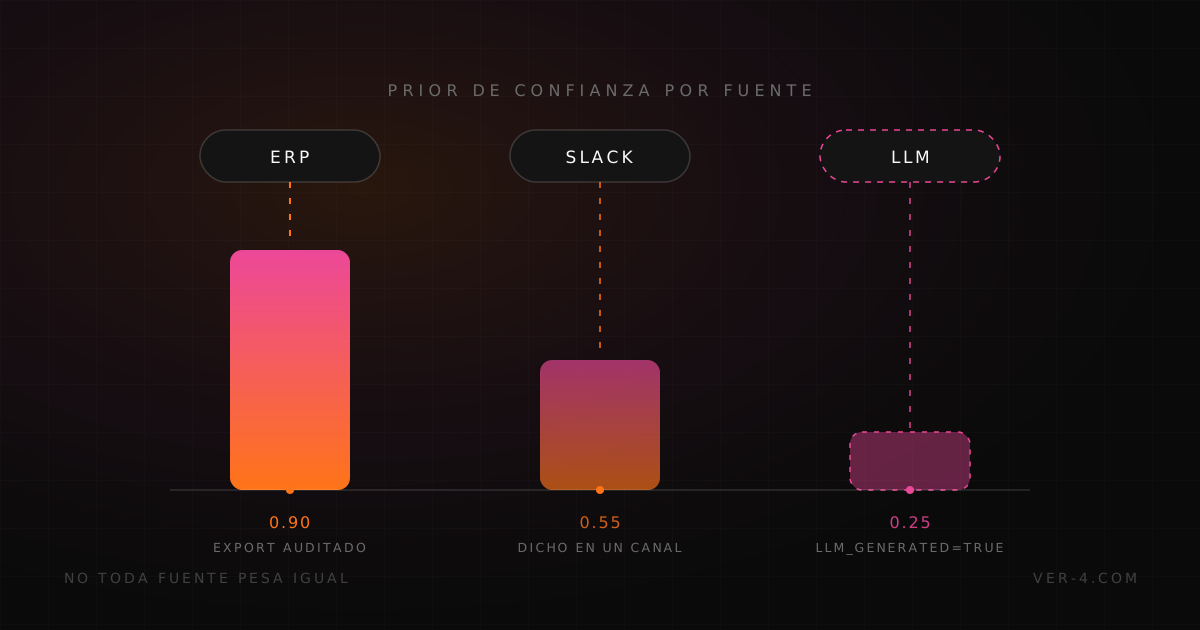
Every data point arrives with a prior: a starting confidence that depends on where it came from. An authoritative record —the ERP, a signed contract, the system of record for that domain— does not weigh the same as a Slack summary or a model's output. Treating them as equals, giving them the same vote, is a design error before it is a data error.
Institutional truth rules
Centro de Verdad assigns priors by source and authority. Every domain has a system of record: for sales, the ERP; for a commitment, the contract; for a ticket's status, the tracker. That origin weighs more — and everything else corroborates; it does not compete as an equal.
Note: a high prior raises the starting point; it does not close the case. An authoritative source that contradicts itself is still a problem. The prior is where you start, not where you end.
The dependence discount
Here is the most deceptive error: corroboration only counts if it is independent. Five dashboards reading from the same export are not five confirmations — they are one, shown five times. Seeing the data point repeated everywhere creates a sense of consensus that does not exist.
Five copies of the same origin are not five proofs. They are one proof, five times.
That is why the system discounts correlated corroboration: it traces which origin each occurrence comes from and does not add up the ones that share a root. Real consensus demands sources that do not copy each other.
The special case: AI-only
A data point backed only by another AI does not reach "verified". A model's output is not validated by citing another model — it takes non-AI corroboration or an anchor in an authoritative record. If all the evidence was born from a machine, the uncertainty stays high on purpose.
Verified · ADR-0003 — authoritative sources
Weighing each source for what it really is —and discounting the ones that copy each other— is what keeps noise from disguising itself as consensus. Without that, repeating a lie enough times turns it into "data".