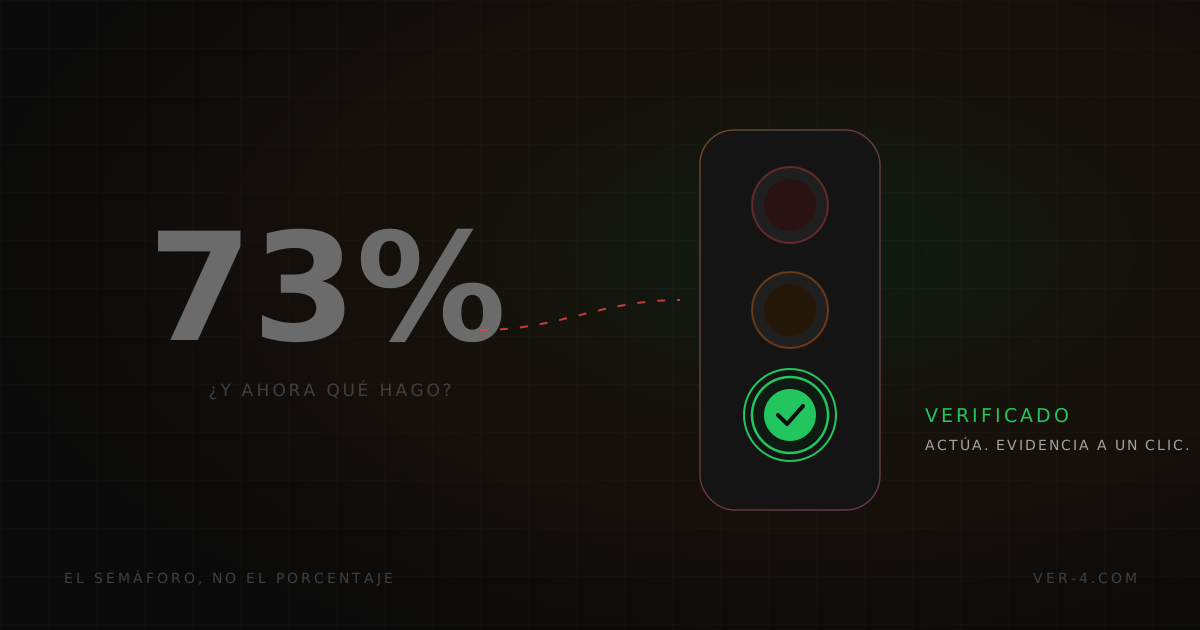
Put yourself in the decision-maker's seat. A report lands on your desk and, next to a figure, a label: "confidence: 73%". Do you use it? Do you double-check it? From what number do you trust it — 80, 90? The percentage did not solve your problem; it handed it back to you, dressed up as precision.
That is the score's underlying flaw: it fakes objectivity and shifts the hard decision back to the human. It looks like a data point, but it is an unanswered question.
Three states you can actually act on
Centro de Verdad does not deliver a decimal. It delivers a traffic light:
- Verified — you can trust it.
- To confirm — support is missing.
- In conflict — the sources do not agree.
Three verdicts, each with the evidence behind it one click away. It is not oversimplifying: it is translating the internal calibration —the belief/doubt/uncertainty opinion, the per-source priors— into something a person can act on in seconds. The hard work is still there; just on the right side.
A percentage makes you feel you decided with data. A verdict with its proof lets you actually decide.
Honest about what it does not know
The opaque score averages everything into a lukewarm number. The traffic light is honest: when something is in conflict, it does not silently pick a source or produce an average — it shows you the two that disagree and lets you resolve it. When something is to confirm, it does not dress it up as "likely": it tells you evidence is missing.
Verified · principle P5 — traceability
Trust is not communicated with decimals. It is communicated with a clear verdict and the proof at hand — so the decision is fast and auditable, not one or the other.