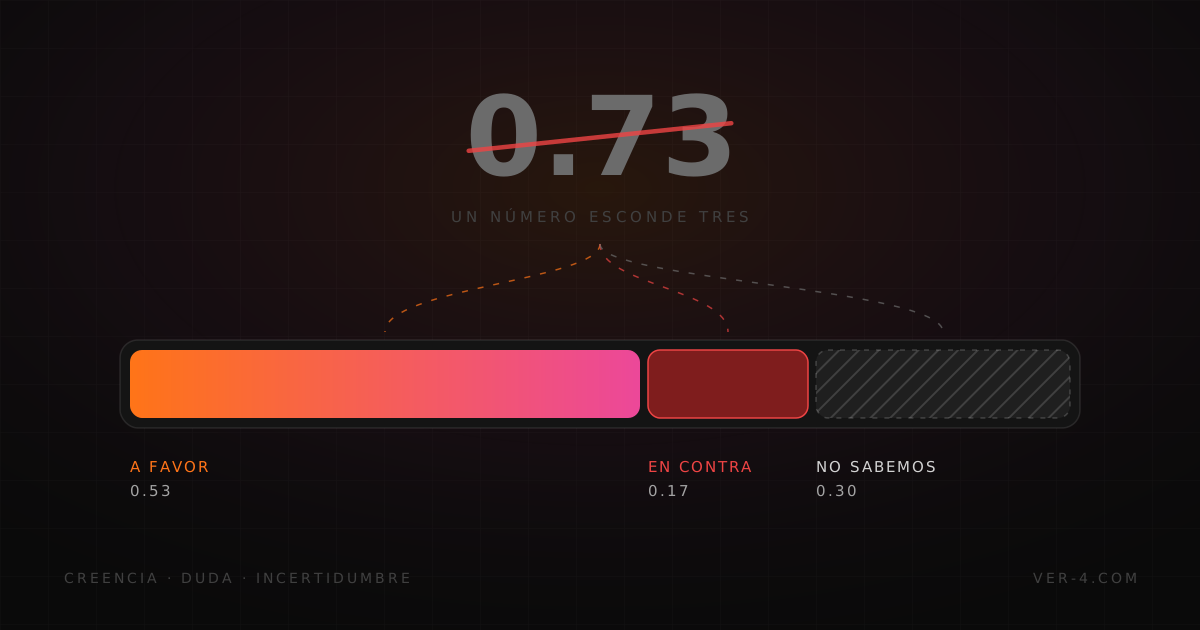
The instinct of every system that evaluates confidence is to summarize it in a number: 0.73, 87%, "high". It is convenient, it fits in a cell, it sorts from highest to lowest. And it collapses, into a single digit, three things that are not the same.
A "73%" can mean "plenty of evidence in favor, a little against". Or it can mean "there is almost no evidence of anything, and the model rounded toward the middle". For the person who has to decide, those two 73% are opposite worlds — and the number does not tell them apart.
Three quantities, not one
Centro de Verdad models every piece of data as a graduated opinion: belief (b), disbelief (d) and uncertainty (u), which sum to 1.
- Belief — evidence that supports the data.
- Disbelief — evidence that contradicts it.
- Uncertainty — what we do not know yet: absence of evidence, not evidence of absence.
A data point with high b and low u is backed. A data point with high u is not "50% likely": it is unknown. And that distinction changes what you should do.
A number tells you how much to trust. A three-part opinion tells you why — and, above all, what you are missing.
Silence is not a midpoint
A real example from the product: "the supplier meets the delivery deadline", with no confirmation anywhere in the system. A score would push it to a lukewarm 50%. The graduated opinion tells the uncomfortable truth: high uncertainty. There is no evidence. The right action is not to bet halfway — it is to request the missing data.
How the opinion moves
The opinion is not static. Independent evidence raises belief; a source that disagrees raises disbelief; silence keeps uncertainty high. With a nuance almost everyone skips: provenance ≠ veracity. A source being reliable raises the prior, but it does not replace corroboration. And copies of the same origin do not count as independent confirmations — seeing it twice in the same system does not make it more true.
Verified · principle P8 — show the uncertainty
Showing uncertainty instead of averaging it away is, exactly, what separates calibrating from asserting. The system does not tell you "trust it 73%". It tells you what supports the data, what puts it in doubt, and how much it still does not know — so you can decide with that in plain sight.