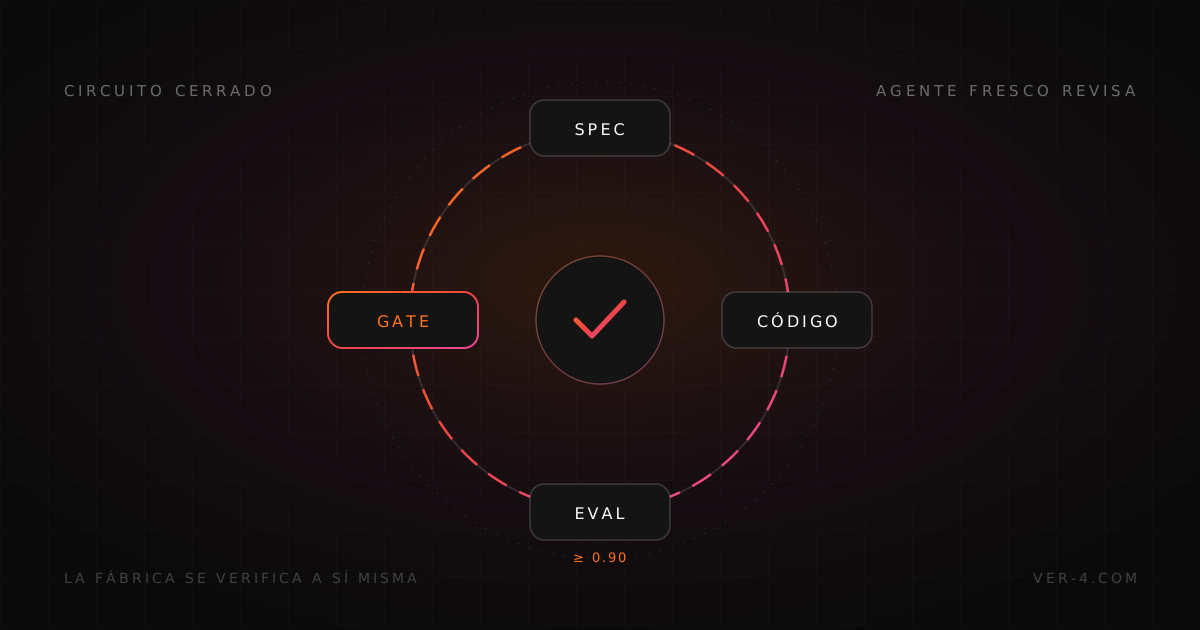
There is an uncomfortable symmetry in what we do. Centro de Verdad exists to verify AI output before someone decides on it. And we build it… with AI. If we did not apply the same standard internally, we would be the joke.
The agent's default is minimum effort
An agent, left to its defaults, picks the option with the least code that passes the tests — not the architecturally correct one. We covered it in detail in "Less code is not better design": green tests are no evidence of good design, because the poor option passes them too. The gap is not in the code; it is upstream, in the design decision, before the spec.
A guardrail that audited itself
Our defense was an Altitude Gate: an adversarial review of the design, done by a fresh agent, upstream of the spec, with a single mandate — hunt minimum-effort poverty, not incorrectness.
The revealing part came later. The first version of the gate let the main agent —the biased one— decide when it should fire. The review of the gate's own design flagged that as critical: if the biased party controls its own valve, the guardrail is theater. The best proof that the mechanism worked was applying it to itself and having it find its own flaw.
A truth engine that does not hold itself to its own standard is not a truth engine. It is marketing.
The same thesis, in both layers
The product's guarantees have an exact mirror in how we manufacture it: evals as gates (nothing moves forward without passing its eval ≥ 0.90), independent verification (the reviewer is not the builder), and auditable memory in git. The factory principles (F1–F9) mirror the product's (P1–P15) — an explicit boundary between how it is built and what is delivered.
Verified · factory/product boundary, FAB-00
Separating what looks correct from what is verified — before the merge, just as before the decision. The coherence is not only the product. It is how we make it.